“In the future, everything that moves will be robotic, everything that moves will be AI-driven… Humanoid robotics is going to potentially be one of the largest industries ever. The idea that there’d be a billion robots [around the world] is a very sensible thing.”
- Jensen Huang, CEO of NVIDIA at GTC 2025 Keynote
We are currently living in what is widely celebrated as the golden age of robotics. From these bold industry visions to the daily breakthroughs in AI, it feels as if the potential growth is limitless. But at the same time, we must face a hard truth: the world HAS limits.
While the industry predicts a future of universal abundance and a billion robots, the planet is signaling a different reality. We have already surpassed seven of the nine planetary boundaries (Kitzmann et al., 2025; Richardson et al., 2023), the effects of climate change are no longer a distant threat, and the calls for urgent, transformative action are louder than ever (Ripple et al., 2017). As roboticists, we have to ask ourselves: are we building this “billion-robot future” with the planet in mind?
To find out, we analyzed 50,000 robotics research articles published in the last decade, and extracted insights into the field’s awareness and motivation regarding sustainability. The takeaway is very clear: with more than 92% of papers not mentioning their broader impact and more than 95% not motivated by sustainability, the community needs to do more!
This article will start with a brief introduction to the role of robotics in the global sustainability agenda. Then, we will describe our analysis pipeline and present the results, showcasing the awareness gaps in the literature. Finally, we will conclude by discussing a set of concrete, actionable steps the community can take to help close these gaps.
Read the Full Study: This page is an interactive version of our recent arXiv publication. If you prefer to read the static PDF or want to dive into the formatted appendices, you can find the complete paper here.
The Brave New World of Robotics
It seems undeniable at this point in time that robotics has a big, bright future. We are witnessing a historic shift where general-purpose robots are starting to show advanced physical abilities, matching and even in some cases surpassing those of humans. Robotics seems more and more as a success story of the modern world, where disruptive innovation, years of research and continuous improvements are creating truly capable systems that were once the stuff of science fiction.
Beyond the impressive physical abilities, with the recent advancements in AI, we are also seeing a significant leap in the cognitive capabilities of robots. The integration of large language models and other AI techniques is enabling robots to understand and interact with the world in more sophisticated ways. We can now clearly imagine these systems performing many useful roles:
- Eliminating dangerous and repetitive work that humans should no longer have to do.
- Optimizing resource management through precision and tireless operation.
- Providing essential care for the elderly in an aging global society.
And many more applications spanning from daily life to industry, healthcare, agriculture, and even space exploration.
In this era of rapid expansion, it feels as if there are no limits to the possibilities and the growth of our field.
But at the same time, we must face a hard truth: the world HAS limits.
Today’s technological development is fueled by an unspoken rule: “if it can exist, it should exist.” This is often coupled with the competitive fear that “if we don’t build it, someone else will.” While this mindset has accelerated innovation, it has also blinded us to a reality that science has warned us about for decades: we live on a finite planet with limited resources (Meadows et al., 1972).
Our “blind progress” paradigm has brought us to an unprecedented global crisis. Scientific evidence, including the latest IPCC reports and recent planetary boundary studies, confirms that we have already surpassed 7 out of the 9 planetary boundaries (Richardson et al., 2023).
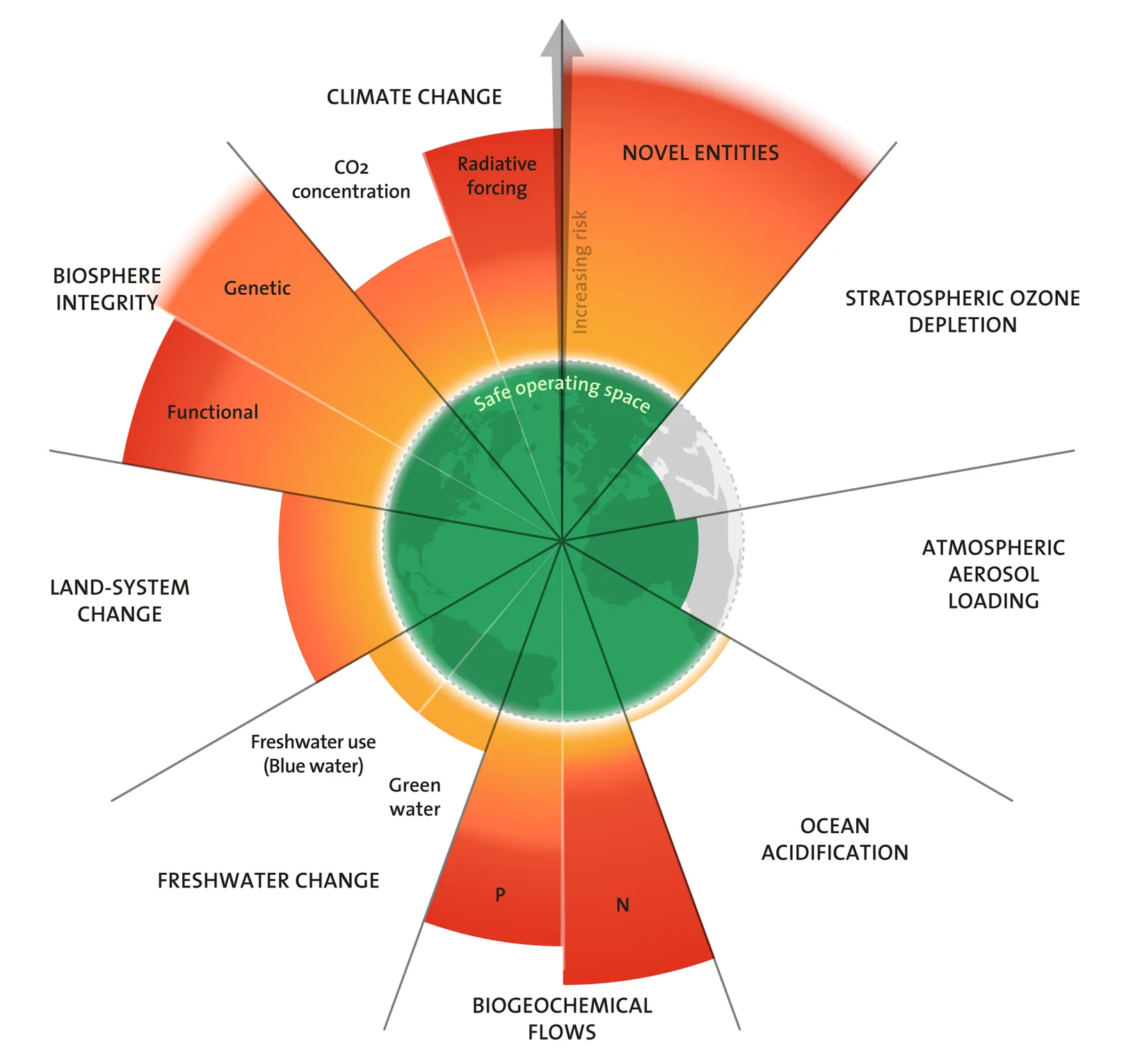
Licensed under CC BY-NC-ND 3.0. Credit: "Azote for Credits Stockholm Resilience Center , based on analysis in Sakschewski and Caesar et al. 2025".
Planetary boundaries define a “safe operating space” for humanity (Rockström et al., 2009), a set of boundaries we should not cross to maintain a stable and hospitable planet. The further we exceed these boundaries, the higher the risk of triggering tipping points: irreversible changes that could threaten the very foundation of the life on Earth as we know it.
According to the latest Planetary Health Check 2025 (Kitzmann et al., 2025), our current trajectory has pushed us into the high-risk zone across multiple fronts:
-
Climate Change: Atmospheric carbon concentrations have long since passed the safe threshold (Richardson et al., 2023), and the average temperature has exceeded 1.5°C in 2024 (the target set by the Paris Agreement).
-
Biosphere Integrity: Biodiversity is being lost at an alarming rate (Johnson et al., 2017)
-
Land-System Change: Deforestation and aggressive land use are destabilizing local and global climate (Chakravarty et al., 2012; Smith et al., 2023)
-
Novel Entities: Chemical pollution and microplastics have become ubiquitous, found in the most remote corners of the Earth (Law & Thompson, 2014; WHO, 2019) and even within the human bloodstream (Cox et al., 2019).
The fact that we have exceeded the majority of the safe operating limits is a clear sign that we need to rethink our approach to innovation. It is a call for urgent action, not just in terms of reducing emissions or conserving resources, but in fundamentally reimagining how we live, work, and innovate.
Achieving true sustainability is often seen as being about ecological concerns and addressing climate change, but this is far from the full picture. It requires acting on many fronts simultaneously: reducing inequalities, managing resource utilization, ensuring peace, and aiming for economic prosperity for all. It is about creating a long-term stable world that considers not just our needs today, but those of future generations and the planet itself (Brundtland, 1987).
The 2030 Agenda for Sustainable Development
In 2015, a pivotal moment for global action occurred. While many remember it as the year of the Paris Agreement, it was also when all United Nations Member States adopted a shared blueprint for a sustainable transition called the 2030 Agenda for Sustainable Development.
“The 2030 Agenda for Sustainable Development, adopted by all United Nations Member States in 2015, provides a shared blueprint for peace and prosperity for people and the planet, now and into the future.”

The common theme in every report is clear: we are falling behind, and the call for urgent, transformative action grows louder every year.
Where does robotics fit into this?
Analogous to AI (Rolnick et al., 2022; Vinuesa et al., 2020), many researchers agree that robotics is a double-edged tool (Bugmann et al., 2011; Guenat et al., 2022).
On one hand, it can have a substantial positive effect and act as a primary engine for the transition to a sustainable world. It can help in many domains, from improving the efficiency of industrial processes to helping in environmental monitoring and improving human well-being with advancements in medical applications. On the other, if we do not explicitly focus on sustainability, it can become part of the problem. Main concerns being: contributing to waste creation, energy and resource depletion, and amplifying social inequity.
More precisely, recent analysis suggests that while robotics has the potential to enable 46% of all SDG targets, it could also inhibit 19% of them: primarily by exacerbating inequalities if not managed with care (Haidegger et al., 2023).
The research community increasingly recognizes that to enable sustainable development, we need a concerted effort to raise awareness, build new tools, and share knowledge. Some recent institutional moves both in the industry and academia reflect this shift, for example:
- In Industry: The International Federation of Robotics (IFR) has published a detailed list of proposals outlining how robotics can contribute to specific SDGs.
- In Academia: The IEEE Robotics and Automation Society (RAS), one of the world’s leading robotics associations, recently established a Sustainability Committee to promote these values in research and practice.
While the global transtion can be accomplished only with a collective effort across all sectors, the research community has a unique role to play. Academic research serves as the foundation for the future of the industry; the ideas, priorities, and ethical frameworks established in today’s papers become the industrial standards of the next decade.
While there is a growing number of papers exploring everything from energy efficiency to social impact (Guenat et al., 2022; Haidegger et al., 2023), it is still not clear how much of the research community is aware of the SDGs and how much of it is actively trying to align with them.
With this in mind, this study attempts to raise awareness of our community by attempting to answer this simple question:
In 2015, the world agreed on a plan for the future. How has robotics research, with its potentially huge future impact, aligned with this goal?
- Brundtland, G. H. (1987). Our common future—Call for action. Environmental Conservation, 14(4), 291–294.
- Bugmann, G., Siegel, M., & Burcin, R. (2011). A role for robotics in sustainable development? IEEE Africon’11, 1–4.
- Chakravarty, S., Shukl, G., & others. (2012). Deforestation: causes, effects and control strategies. Global Perspectives on Sustainable Forest Management.
- Cox, K. D., Covernton, G. A., Davies, H. L., Dower, J. F., Juanes, F., & Dudas, S. E. (2019). Human consumption of microplastics. Environmental Science & Technology, 53(12), 7068–7074.
- Guenat, S., Purnell, P., Davies, Z. G., Nawrath, M., Stringer, L. C., Babu, G. R., Balasubramanian, M., Ballantyne, E. E., Bylappa, B. K., Chen, B., & others. (2022). Meeting sustainable development goals via robotics and autonomous systems. Nature Communications, 13(1), 3559. back: 1, 2
- Haidegger, T., Mai, V., Mörch, C. M., Boesl, D., Jacobs, A., Khamis, A., Lach, L., Vanderborght, B., & others. (2023). Robotics: Enabler and inhibitor of the sustainable development goals. Sustainable Production and Consumption, 43, 422–434. back: 1, 2
- Johnson, C. N., Balmford, A., Brook, B. W., Buettel, J. C., Galetti, M., Guangchun, L., & Wilmshurst, J. M. (2017). Biodiversity losses and conservation responses in the Anthropocene. Science, 356(6335), 270–275.
- Kitzmann, N., Caesar, L., Sakschewski, B., Rockström, J., Andersen, L., Bechthold, M., Bergfeld, L., Beusen, A., Billing, M., Bodirsky, B. L., & others. (2025). Planetary Health Check 2025: A scientific assessment of the state of the planet. back: 1, 2
- Law, K. L., & Thompson, R. C. (2014). Microplastics in the seas. Science, 345(6193), 144–145.
- Meadows, D. H., Meadows, D. L., Randers, J., & Behrens III, W. W. (1972). The Limits to growth; a report for the Club of Rome’s project on the predicament of mankind. New York : Universe Books, [1972]. https://search.library.wisc.edu/catalog/999473210902121
- Richardson, K., Steffen, W., Lucht, W., Bendtsen, J., Cornell, S. E., Donges, J. F., Drüke, M., Fetzer, I., Bala, G., von Bloh, W., Feulner, G., Fiedler, S., Gerten, D., Gleeson, T., Hofmann, M., Huiskamp, W., Kummu, M., Mohan, C., Nogués-Bravo, D., … Johan Rockström. (2023). Earth beyond six of nine planetary boundaries. Science Advances, 9(37), eadh2458. 10.1126/sciadv.adh2458 back: 1, 2, 3
- Ripple, W. J., Wolf, C., Newsome, T. M., Galetti, M., Alamgir, M., Crist, E., Mahmoud, M. I., Laurance, W. F., & scientist signatories from 184 countries, 15364. (2017). World Scientists’ Warning to Humanity: A Second Notice. BioScience, 67(12), 1026–1028. 10.1093/biosci/bix125
- Rockström, J., Steffen, W., Noone, K., Persson, \AAsa, Chapin, F. S., Lambin, E. F., Lenton, T. M., Scheffer, M., Folke, C., Schellnhuber, H. J., & others. (2009). A safe operating space for humanity. Nature, 461(7263), 472–475.
- Rolnick, D., Donti, P. L., Kaack, L. H., Kochanski, K., Lacoste, A., Sankaran, K., Ross, A. S., Milojevic-Dupont, N., Jaques, N., Waldman-Brown, A., Luccioni, A. S., Maharaj, T., Sherwin, E. D., Mukkavilli, S. K., Kording, K. P., Gomes, C. P., Ng, A. Y., Hassabis, D., Platt, J. C., … Bengio, Y. (2022). Tackling Climate Change with Machine Learning. ACM Comput. Surv., 55(2). 10.1145/3485128
- Smith, C., Baker, J., & Spracklen, D. (2023). Tropical deforestation causes large reductions in observed precipitation. Nature, 615(7951), 270–275.
- Vinuesa, R., Azizpour, H., Leite, I., Balaam, M., Dignum, V., Domisch, S., Felländer, A., Langhans, S. D., Tegmark, M., & Fuso Nerini, F. (2020). The role of artificial intelligence in achieving the Sustainable Development Goals. Nature Communications, 11(1), 233.
- WHO, W. H. O. (2019). Microplastics in drinking-water.
Analysis of the Current State: A Large-Scale Survey
The goal of this analysis is to quantify how the robotics community actually communicates its work. More precisely we are interested in answering two main questions:
- How often authors communicate the potential impacts of their work (social, sustainability, ecological)?
- How often papers are actually motivated by sustainability-related topics?
Additionally, how does this evolve over time? Is it improving?
While several studies have explored the intersection of robotics and sustainability through human assessment on a small scale, such as the expert evaluation by Guenat et al. (2022), there has been no real large-scale study on the field’s overall direction until now.
Therefore, to answer these questions, we conducted a large-scale analysis of the entire
corpus of open-access robotics research available on ArXiv (tagged by cs.RO category),
covering the period from 2015 to early 2026.
This dataset includes close to 50,000 papers, providing a comprehensive
view of the field’s evolution since the adoption of the UN SDGs in 2015.
Arxiv database does not contain ALL roobtics articles. There are other closed-access databases, namely IEEE Xplore and Science Direct, that may contain additional papers not found on Arxiv. However, Arxiv is the largest open-access repository for robotics research, and it provides a sufficiently large and representative sample to analyze broad trends in the field’s communication about sustainability.
The Analysis Approach
Answering the above questions required a combination of quantitative keyword analysis and qualitative content analysis. Both of these analyses might take a human researcher years to complete due to the sheer volume of papers.
With the recent advances in Large Language Models (LLMs), increasing number of studies showed that the LLM-based classification methods, providing the LLM with a well-structured prompt as well as a complete taxonomy of labels, are effective tools for classifying text at scale (Vajjala & Shimangaud, 2025; Wang et al., 2023). Therefore, for this large-scale study, we opted for a zero-shot LLM-based classification approach.
We built our analysis pipeline using DeepSeek-V3, chosen for being open-weight, as well as for its reasoning capabilities and large context window, which allowed us to process the full contents of each paper.
In this study, the model was tasked with analyzing each paper against two specific criteria:
- identify presence of impact-related keywords
- classify the research based on its alignment with the SDGs.
The classification was framed as a zero-shot approach utilizing a double (system + per-paper) prompt structure. Find the full prompt details in the Appendix: Prompt details & Examples.
Ultimately, the goal of this analysis is not to provide a 100% infallible judgment on every paper, but to point toward the emerging trends in how our community prioritizes (or overlooks) sustainability in their communications. Therefore, while an LLM-based approach may not be as precise as a human expert on every single paper, it provides a consistent and scalable way to analyze tens of thousands of papers and identify broad patterns that would be impossible to detect through manual analysis alone. The limitations of this approach are further discussed in the Appendix: Limitations of the approach.
Deep Dive into Methodology: For a more rigorous breakdown of our pipeline, including classification performance, consistency checks for DeepSeek-V3, and cross-model ensemble benchmarking, please refer to our full arXiv preprint.
The dataset and the code is Open-Source
The full dataset of analyzed papers, including the model’s classifications and reasoning, is available for download on Hugging Face Datasets:
In addition to the dataset the code pipeline used for the analysis is also open-source and available on GitHub: huggingface/arxiv-robotics-sustainability-classification.
Try on your own paper!
Try the same analysis on your own paper or any paper you are interested in! The interactive demo is open-source and available on Hugging Face Spaces - Sustainability Assessment Tool
The Footprint of Our Analysis
In the spirit of the sustainability goals we advocate for, it is vital to be transparent about the environmental cost of this study itself. Large-scale AI analysis is not “free” for the planet.
| Metric | Value |
|---|---|
| Model Used | DeepSeek-V3 |
| Deepseek’s Carbon Intensity Factor (CIF) | ~0.6 kgCO2e / kWh - Table 1. in Jegham et al. (2025) |
| Data Volume | ~1.2 Billion tokens exchanged |
| Prompt Number | ~50,000 |
| Average Prompt Size | Input: ~25k tokens, Output: ~750 tokens |
| Estimated Energy Per Prompt | ~13Wh - Table 4. in Jegham et al. (2025) |
| Estimated Carbon Footprint Per Prompt | ~7.8g CO2e (0.6 kgCO2e / kWh 13 Wh) |
| Total Energy Consumption | ~650 kWh |
| Total Carbon Footprint | ~390 kgCO2e |
| Total Experimental budget | ~250$ |
Putting 650 kWh into context:
-
Yearly energy consumption per inhabitant: This is equivalent to 29% of the average yearly electricity consumption of an inhabitant in France (2,223 kWh).
-
Yearly PC energy consumption: It represents 3x to 6x the total yearly energy consumption of a standard desktop PC (assuming 100-200 kWh/year) and 12x the consumption of a standard notebook (50 kWh/year).
Putting 390kg of CO2 into perspective using common environmental equivalents:
-
Driving: Equivalent to driving a standard gasoline passenger car for ~1500 km (~400gCO2e/mile). Rougly the distance between Paris and Rome.
-
Flying: Equivalent to a return-trip flight from London to Barcelona, about ~1500km (~0.25kgCO2e/km).
-
Tree absorption: It would take approximately 39 mature trees an entire year (10 kg/year) to sequester the carbon produced by this specific experimental run.
-
Personal footprint: It represents 2.6% of the average yearly carbon footprint of an inhabitant in USA (14.5 tCO2e/year). But a 19% of the target yearly carbon footprint per capita to meet the 1.5°C target (2 tCO2e/year).
Note: While this “one-time cost” is significant, we believe the insight gained, identifying the Awareness Gap in a field that influences global industry, is a necessary investment to trigger a shift toward more intentional, sustainable research.
- Guenat, S., Purnell, P., Davies, Z. G., Nawrath, M., Stringer, L. C., Babu, G. R., Balasubramanian, M., Ballantyne, E. E., Bylappa, B. K., Chen, B., & others. (2022). Meeting sustainable development goals via robotics and autonomous systems. Nature Communications, 13(1), 3559.
- Jegham, N., Abdelatti, M., Koh, C. Y., Elmoubarki, L., & Hendawi, A. (2025). How hungry is ai? benchmarking energy, water, and carbon footprint of llm inference. arXiv Preprint arXiv:2505.09598. back: 1, 2
- Vajjala, S., & Shimangaud, S. (2025). Text Classification in the LLM Era–Where do we stand? arXiv Preprint arXiv:2502.11830.
- Wang, Z., Pang, Y., & Lin, Y. (2023). Large language models are zero-shot text classifiers. arXiv Preprint arXiv:2312.01044.
Analysis Results
The large-scale analysis of the dataset of 50,000 papers in the ArXiv Robotics category (cs.RO), revealed several interesting trends
in the scientific communications of the robotics community:
- The field of robotics is growing exponentially, with a significant increase in the number of papers published over the years.
- The Awareness Gap: Very few papers mention their impacts (social, sustainability, ecological), and this proportion has not shown significant improvement over time.
- The Motivation Gap: Very few papers are explicitly motivated by sustainability-related topics, but many of them are treating topics that could benefit sustainability without explicitly mentioning it.
Following sections will dive into each of these trends in more detail.
The Exponential Growth of Robotics Research
The first and most obvious trend in our dataset is the sheer volume of research being produced. The growth of the field is impressive, from 80 papers in the first quarter (Q1) of 2015, to over 3,100 papers in the first quarter (Q1) of 2026. The growth rate is exponential: the number of papers is multiplied by 2 roughly every 3 years.
Another interesting observation is that the months of March and September are consistently the most popular for paper submissions, likely due to conference ICRA (September-November) and IROS (February-March) deadlines. While January is the least popular month for submissions. However, the overall growth trend is clear regardless of the month or quarter.
How many papers mention their impacts?
To better understand how the community communicates “the impact” of their work, we analysied the papers to find the explicit mentions of their impact in three key areas:
- Social Impact
- Ecological Impact
- Sustainability Topics
Additionally, we looked for explicit references to the UN’s Sustainable Development Goals (SDGs) to see if this global framework has penetrated the robotics lexicon.
The data reveals a contrast between the growth of the field and the growth of its engagement:
- Stagnant Proportion of Impact Mentions: While the absolute number of papers mentioning impact is increasing, this seems to be more of a byproduct of the field’s exponential growth than the result of a genuine increase in awareness. The proportion of papers discussing these impacts has remained surprisingly stagnant for over a decade.
- Marginal Impact Consideration: Very few papers explicitly consider their broader impacts. Mentions of Social Impact are around 6%, while Environmental and Sustainability impacts both struggle to cross the 2% threshold.
- UN SDGs Rarely Mentioned: Explicit mentions of the UN SDGs are nearly non-existent, appearing in fewer than 0.1% of all papers. Despite being the global standard for sustainable development, the SDGs appear to be largely absent from the robotics research communications.
It is important to note that we are only looking for explicit mentions of these impacts in the papers, and we did not try to analyse the quality of the arguments or the depth of the discussion. We are are not trying to understand if the paper is actually impactful or not. Even greenwashing would be considered as a mention of the impact.
For a more granular view, the interactive plot below allows you to inspect quarterly data and observe these trends across the entire study period.
The data paints a somewhat grim picture of our field, of a field rarely engaging with the broader consequences of our work. Despite numerous calls for responsible research and the increasing visibility of sustainability issues, the vast majority of robotics papers do not explicitly address their social, ecological, or sustainability impacts. And the proportion of papers that do mention these impacts has not shown significant improvement over time.
We must do more as a community! As researchers, we need to look past purely technical and economic metrics and start taking responsibility for the broader impacts of our work. As we are helping to build this “billion-robot future,” we have a duty to consider the social, ecological, and sustainability consequences of what we create. At the very least, we should begin by making these impacts a standard part of our scientific communications.
How many papers are motivated by sustainability related topics?
In this step, we moved beyond keywords and looked at the actual content of the articles. We wanted to understand how many robotics papers are describing technologies that are useful for the sustainability goals (Potentially applicable) and how many of them sustainability as their primary driver (Motivated by sustainability).
Using the UN SDGs as our guide, we categorized the 50,000 papers into three distinct categories based on their relevance and motivation towards sustainability goals:
- SDG Aligned: Papers that develop technology that could benefit an SDG (e.g., efficient industrial path planning, medical robotics for health).
- SDG Motivated: Papers which are SDG aligned but also explicitly mention the sustainability as a motivation for their work.
- No Direct SDG Relevance: Papers focused on niche technical problems with no clear link any of the sustainability goals.
For example, a paper about efficient path planning for industrial robots would be classified as relevant for SDG 9 (SDG Aligned), but it would only be classified as SDG Motivated by SDG 9 if the paper explicitly mentions that the motivation of the work is to contribute to any of the SDG 9 targets (e.g., “This work is motivated by the need to promote sustainable industrialization and foster innovation”).
First let’s look at how many papers are SDG Aligned, or in other words, how many papers (out of the total of 50,000 ) are classified as relevant for specific SDGs. The absolute view graph presents the analysis results and shows a clear hierarchy of priorities:
- Most Represented Topics
- Industrial topics: Unsurprisingly, the vast majority of research falls under technological advances for Industrial Innovation (SDG 9) with 87% of papers, followed by: Smart Cities/Infrastructure (SDG 11) with 43% of papers, Decent Work and Economic Growth (SDG 8) with around 10% of papers and Responsible Consumption and Production (SDG 12) with around 6% of papers. All of them are likely driven by the industrial and manufacturing applications of robotics, improving efficiency, and optimizing processes.
- Human Well-being: The third-largest category is Good Health and Well-being (SDG 3) with around 19% of papers, likely driven by the strong sub-field of medical and assistive robotics.
- Least Represented Topics
- Environmental Topics: In contrast environmental topics such as Climate Action (SDG 13), Life on Land (SDG 15), Life Below Water (SDG 14) and Clean Energy (SDG 7) are much less represented, with each of these SDGs having less than 2.5% of papers.
- Social Topics: Somewhat expectedly the social SDGs such as No Poverty (SDG 1), Peace, Justice and Strong Institutions (SDG 16), Gender Equality (SDG 5) and Reduced Inequalities (SDG 10) are also underrepresented, with each of these SDGs having less than 2.5% of papers.
- No SDG Relevance: Interestingly, a very small portion of papers (around 0.3%) were classified as having “No Direct SDG Relevance,”. Highlighting the field’s high potential to contribute to global goals, but it also suggests that the UN SDGs are a broad framework capable of encompassing almost any technical advancement.
A Note on the 99% Relevance Rate
It is important to recognize that these numbers are sensitive to the classification methodology. With a stricter LLM prompt and a more conservative classification requirements, we would likely find a lower overall proportion of SDG relevance. However, this would most probably impact both the “SDG Aligned” and “SDG Motivated” values equally, leaving the considerable gap between potential and intent relatively unchanged.
Finally, the above graph shows that the overall number of papers motivated by SDG topics (SDG Motivated) is very low in comparison to the number of papers treating topics that are somewhat aligned with SDGs (SDG Aligned). The graph bellow and the following discussion dives a bit deeper into this relationship.
We are now interested in the proportion of the papers that are explicitly motivated by their contribution to this topic (SDG Motivated) per SDG topic, compared to the papers that are not explicitly motivated by it (but still classified as relevant for it, SDG Aligned). The results are shown on the relative view graph, and they show a great motivation disparity between domains:
- Highly motivated domains:
- No Poverty (SDG 1): This SDG is at 100% of papers motivated by it, but this SDG has only one paper classified under it, so it is safe to say that this result is an outlier and should not be over-interpreted.
- Human Well-being: Fields like Health (SDG 3), Zero Hunger (SDG 2), Clean Energy (SDG 7) and Clean Water and Sanitation (SDG 6) have relatively high rates of explicit motivation (typically much above 10%). Notably, SDG 2 (Zero Hunger) has the highest relative proportion of explicit motivation (30%), reflecting the urgent need for technological solutions in agriculture.
- Environmental SDGs: Climate Action (SDG 13), Life on Land (SDG 15) and Life Below Water (SDG 14) also show a relatively high proportion of explicit motivations (>10%), likely due to the increasing visibility of environmental issues and the clear need for technological solutions in these areas.
- Social SDGs: Reduced Inequalities (SDG 10), Gender Equality (SDG 5) and Peace, Justice and Strong Institutions (SDG 16) show a similar proportion of explicit motivations (>5%), likely due to the clear and direct impact on people’s lives and the strong ethical considerations in these domains.
- Moderately motivated domains:
- Responsible manufacturing In Responsible Consumption and Production (SDG 12) and Decent Work and Economic Growth (SDG 8), around 2.5-5% of papers are explicitly motivated by these SDGs, it is somewhat surprising given the importance of sustainable production practices.
- Education: With around 3% of papers explicitly motivated by this SDG, education is a moderately represented domain. This may be due to the growing interest in educational robotics and the potential for technology to enhance learning experiences.
- Low motivation domains:
- Technical/Industrial Domains: Conversely, in Industrial Innovation (SDG 9) and Sustainable Cities and Communities (SDG 11), the proportion of papers explicitly motivated by these SDGs is very low (typically well under 2%). This is likely because much of the research in these areas is driven by technical challenges and industrial applications, rather than sustainability goals.
The results suggest that the robotics community has a high potential to contribute to sustainability goals, but the motivation to do so is unevenly distributed across different domains. More precisely, the domains with the most direct and visible potential sustainability impact (e.g., health or environment) are also the ones with the highest proportion of SDG Motivated papers. However, in heavily technical or industrial domains where the sustainability impact is systemic, indirect and not as visible, the motivation to contribute to sustainability goals is much lower.
Although this seems somewhat intuitive, it also highlights the need for greater awareness and incentives to encourage researchers across all domains to consider the sustainability implications of their work and to explicitly align their motivations with global sustainability goals.
Check out the interactive banner image at the top of this article to explore the landscape of the SDGs in robotics research and see how different SDGs are represented across the field. Click here to go to the top of the banner Link.
The above figure shows the temporal trend of papers explicitly motivated (classified as SDG Motivated) by sustainability topics (cumulatively in all SDGs) compared to the total number of papers. The absolute number of SDG Motivated papers has increased over time which is a great sign! However, the increase seems to keep pace with the overall growth of the field, resulting in a relatively flat percentage trend line. The ratio of motivated papers is hovering around a very low value of under 5% on average, indicating that the vast majority (above 95%) of robotics research is not motivated by sustainability-related topics.
Given the urgency of recent calls to action and the enormous potential for robotics to contribute to sustainability goals, the community needs to do better! It is time to move beyond technical challenges and begin explicitly integrating sustainability into the foundation of our research motivations.
Conclusion and call to action
Robotics research is at a crossroads. While the field is living through a “golden age” of technical advancement, its growth is decoupled from the most pressing challenges of our time.
Our analysis of 50,000 papers has revealed a persistent Awareness Gap and a significant Motivation Gap. The community is building tools that have the potential to drive the global sustainable transition, but they are doing so largely by accident. More than 95% of papers do not consider sustainability when motivating their work, and the proportion of researchers explicitly considering their sustainability and ecological impacts has remained stagnant for over a decade, typically accounting for less than a couple of percentage points of the total research output each year.
More precisely, the analysis of the last decade of papers shows that:
- The ratio of papers mentioning social, environmental, or sustainability impact stayed under 6%, 2% and 1.5% respectively.
- The number of papers explicitly motivated by sustainability (even by a single sentence) stayed under 5%.
- Explicit mentions of the UN SDGs are nearly non-existent, appearing in under 0.1% of the total research.
If we are to meet global sustainability targets, “accidental sustainability” is no longer enough. Robotics community needs to transition toward a paradigm of intentional impact.
Where to start?
Scientists across academia are increasingly recognizing the need to align research with global sustainability targets, as reflected in a growing number of public calls to action across the scientific community. Some of the most well known ones are “World Scientists’ Warning to Humanity”, signed by more than 15,000 scientists (Ripple et al., 2017) and “World Scientists’ Warning of a Climate Emergency”, signed by more than 11,000 scientists (Ripple et al., 2020).
Change in academia is often slow, but it starts with individual choices and institutional pressure. Here are a couple of concrete steps we, as researchers, can take to start bridging the Awareness and Motivation Gaps in our community:
1. Write the “Missing” Section and spend a moment to think about impact
The simplest way to help bridging the Awareness Gap is to make impact a standard part of the scientific narrative. In your next paper, include a dedicated section/paragraph addressing:
- Broad Impacts: What are the social, ecological, and sustainability consequences of this work?
- SDG Alignment: Which specific UN goals does this research support?
- Stated Intent: Whenever possible, frame your research motivations with sustainability in mind from the outset, rather than as an afterthought.
If not sure which SDGs your research aligns with, check the section Test your paper! to analyse your paper using the sustainability assessment tool developed for this article.
2. Open-Source Your Research!
Another relatively simple and highly actionable way of contributing to the sustainable future is Open-Sourcing your research.
-
Democratise Access: One of the key concerns for the future of sustainability in robotics is the amplification of global inequalities (Guenat et al., 2022; Haidegger et al., 2023). Open-sourcing our research is a direct way to democratize access, ensuring these technologies are available to everyone, not just a privileged few.
-
Transparency: By making our code and data publicly available, we can allow others to analyse and critique our work, helping to ensure that research aligns with ethical and sustainability principles before it reaches industrial scale.
-
Enhance Collaboration and Knowledge sharing: Collaboration and Knowledge sharing is an important part of the sustainability paradigm, highlighted in SDG 17 (Partnerships for the Goals). Interestingly. Our survey found that SDG 17 is the only goal with zero papers explicitly motivated by it, open-source can be a powerful tool to begin filling this gap.
-
Avoid “Reinventing the wheel”: By allowing others to build upon existing work, we reduce the redundant consumption of energy, compute, and human resources, accelerating our collective progress toward more sustainable future (Bertram, 2020).
3. Explore “Under-Researched” Domains
As shown in the Results section, robotics is currently heavily concentrated in Industry (SDG 9) and Infrastructure (SDG 11). Recent literature indicates that there is a high potential for robotics to contribute to a wide range of SDGs (Haidegger et al., 2023), but many of these areas remain underexplored. This represents a great opportunity in less-covered SDGs. As shown on the figure above, some SDGs could use more robotics community attention, for example:
- SDG 13, 14, & 15: Climate Action and Ecosystem Protection.
- SDG 5 & 10: Reducing Inequalities and Gender Equality.
- SDG 2: Zero Hunger through sustainable agricultural robotics.
- And basically any domain except SDG 9 (Industry) and SDG 11 (Infrastructure), which are already heavily covered.
IEEE RAS’ recently formed Sustainability and Climate Change Committee has published the Call for Sustainability Grants twice in 2025. The grant offers support for research projects that address sustainability challenges, and might be a great opportunity for researchers to get funding for their initial exploration into this topic. We encourage everyone to keep an eye out for future grant opportunities from this committee.
4. Participate in the Conversation
One of the potential reasons the Awareness and Motivation Gaps are so significant is the limited presence of these topics in our daily professional discourse. In order to shift the culture of our field and encourage more researchers to consider these factors in their work, we as a community need to normalize these discussions in our labs, at conferences, and in our papers.
This can take many forms and every bit helps, for example:
- Participate in events: Join workshops, panels, seminars, conferences, etc. By participating,you help raise awareness and signal to organizers that these topics are a priority for the community.
- Be Vocal: Talk to your colleagues and students about the importance of aligning research with global challenges. Express the importance of sustainability in your papers, talks, and social media posts.
Engaging with others helps create a sense of community for those who might otherwise feel they are alone in prioritizing these issues. Normalizing the “Why” behind our research is the first step toward a more intentional field.
ICRA 2026 in Vienna has a Workshop on Circular Robotics: Designing Sustainable Autonomy for a Finite World
This is a great opportunity to get involved in the conversation and contribute to the growing body of work on sustainable robotics. We encourage everyone to submit their work and/or participate in this workshop and help raise awareness about these important issues.
5. Institutional and Conference Awareness
To achieve larger, more systemic and long-term changes the individual effort needs institutional support.
The robotics community can advocate for major venues, like ICRA or IROS to :
- Commit to Transparency: Be explicit about their sustainability engagement and environmental footprint.
- Implement Guiding Policies: Implement policies that encourage or even require authors to consider the sustainability implications of their work.
This could be as simple as adding a section in the submission template for impact statements or sustainability assessments. But also more ambitious structural changes could be implemented, for example by:
- Adding sustainability as a review criterion,
- Adding additional sustainability-focused tracks and workshops.
- Mandating impact statements or sustainability assessments for all submissions.
When the field’s top conferences prioritize these values, the rest of the community will follow.
A very good positive example of such move was IEEE HRI 2025. The conference had a special theme on “Robots for a Sustainable World” and a dedicated Sustainability Chair. This year’s conference IEEE HRI 2026 went a step further with “Sustainability Recognition” for papers and encouraged all authors to consider the sustainability implications of their work. This is a great step in the right direction and we hope to see more conferences following this lead in the coming years.
Final Word
We have already surpassed seven of the nine planetary boundaries. The “blind progress” paradigm, the idea that technology should exist simply because it can, is no longer viable.
Research tells us that robotics has the potential to be a powerful force for good, but only if we intentionally steer it in that direction.
So let’s choose to be part of the solution, not part of the problem.
- Bertram, A. (2020). Don’t Reinvent the Wheel. In Building Better PowerShell Code: Applying Proven Practices One Tip at a Time (pp. 13–15). Apress. 10.1007/978-1-4842-6388-4_2
- Guenat, S., Purnell, P., Davies, Z. G., Nawrath, M., Stringer, L. C., Babu, G. R., Balasubramanian, M., Ballantyne, E. E., Bylappa, B. K., Chen, B., & others. (2022). Meeting sustainable development goals via robotics and autonomous systems. Nature Communications, 13(1), 3559.
- Haidegger, T., Mai, V., Mörch, C. M., Boesl, D., Jacobs, A., Khamis, A., Lach, L., Vanderborght, B., & others. (2023). Robotics: Enabler and inhibitor of the sustainable development goals. Sustainable Production and Consumption, 43, 422–434. back: 1, 2
- Ripple, W. J., Wolf, C., Newsome, T. M., Barnard, P., & Moomaw, W. R. (2020). World scientists’ warning of a climate emergency. BioScience, 70(1), 8–100.
- Ripple, W. J., Wolf, C., Newsome, T. M., Galetti, M., Alamgir, M., Crist, E., Mahmoud, M. I., Laurance, W. F., & scientist signatories from 184 countries, 15364. (2017). World Scientists’ Warning to Humanity: A Second Notice. BioScience, 67(12), 1026–1028. 10.1093/biosci/bix125
Greetings
Big thanks to the following people for their insightful feedbacks!
Thanks Thibaud for the help with the visuals!
Appendix
Supplementary technical details, prompts, and examples. This section is for readers interested in methodology and reproducibility. It is not essential for understanding the main conclusions of this work.
Deep Dive into Methodology: For a more rigorous breakdown of our pipeline, including classification performance, consistency checks for DeepSeek-V3, and cross-model ensemble benchmarking, please refer to our full arXiv preprint.
Prompt Details & Examples
To ensure the AI was looking for the right signals, we provided it with the full text of the UN SDG targets
📑 Download UN SDG TargetsAs well as the full text of the IFR SDG proposals for robotics, which we used as a reference for the model to identify sustainability motivations and alignments in papers.
📑 Download IFR SDG ProposalsThe agent was then prompted with a structured prompt (see below) designed to prepare the model for the task of analyzing each paper, and then with a specific prompt for each paper (see below). This prompt is trying to avoid leading the model towards optimistic or pessimistic interpretations, and to ensure that it provided clear reasoning and concise answers for its conclusions.
System prompt
My aim is to assess and quantify how often robotics research is explicitly
motivated by sustainable development, to raise awareness about the
prioritization of sustainability in the field. You are an expert in
analyzing academic papers for their impact on the UN Sustainable
Development Goals (SDGs) and related environmental or social impacts.
Your task is to analyze the provided paper and identify which SDGs it
most directly supports, based on its content.

Use the full list of 17 SDGs and targets:
{sdg_text}

Also use the following text as a reference for the SDGs and targets.
It shows the proposals of the International Federation of Robotics (IFR)
on how robots can help achieve the SDGs:
{ifr_text}

Respond in the format:

Point 0. provide the type of the paper (survey, experimental, theoretical, report or other -
or a combination of these).
If you are not sure, just say "other".
Point 1. SDGs and targets the paper is explicitly motivated by or aims to address (i.e., the
         problem or impact the authors are directly targeting).
Point 2. provide a list of SDGs and targets SDGs and targets relevant to the technologies or
         methods developed in the paper, even if not mentioned or motivated by sustainability.
         This list should include SDGs the list in point 1.
Point 3. check if the terms "sustainability", "ecological impact", "social impact" or their
         derivatives are mentioned in the text, and provide a yes/no answer for each.
         Also check if the authors mention the UN's 17 sustainable development goals explicitly.
Point 4. **IFR Proposals:** Does the paper results/technology coincide with the International
        Federation of Robotics (IFR) proposals for supporting SDGs? Provide a list of the the
        SDGs the paper supports according to the IFR proposals, and a list of matching IFR
        use cases (quote or paraphrase from IFR proposals). If the paper does not match any
        IFR proposal, provide an empty list.
Point 5. provide a reasoning for the choices made in points 0-3, with quotes from the paper if
         possible, make it concise and to the point.
Each paper’s PDF was parsed into text and fed into the model with a prompt designed to extract the relevant information. The prompt was designed to require structured, classification-like, responses detailing papers’ explicit and implicit alignment as well as their communication of impact. Additionally, the model was prompted for a concise explanation of their choice (Point 5) to ensure the model’s conclusions were based on the content of the paper.
Individual paper prompt
Title: {paper_title}
Full paper text:
"""
{paper_text}
"""

Do not be verbose, keep it concise.
Do not be overly optimistic or pessimistic, just state the facts.
If not enough information is available, say so and provide with
empty lists or "unknown" where appropriate.

Respond in the format:
---------------------------
0. Paper type: [survey, experimental, theoretical, report, other]
1. SDGs and targets the paper is explicitly motivated by or aims
   to address (i.e., the problem or impact the authors are directly targeting)
   only if they are motivated by sustainability not the technology itself:
   - SDGs: [SDG X, SDG Y, ...]
   - Targets: [[X.Y, X.Z, ...], [X.Y, ...], ...]
   - Quote(s) from the motivation/introduction.
2. SDGs and targets relevant to the technologies or methods developed in
   the paper, even if not motivated by sustainability but mentioned in the text:
   - SDGs: [SDG X, SDG Y, ...]
   - Targets: [[X.Y, X.Z, ...], [X.Y, ...], ...]
   - Brief justification for each.
3. Authors mention in the text:
   - UN SDGs: yes/no
   - Sustainability impact: yes/no
   - Ecological impact: yes/no
   - Social impact: yes/no
4. **IFR Proposals:** Does the paper results/technology coincide with the
International Federation of Robotics (IFR) proposals for supporting SDGs?
   - IFR-aligned SDGs/targets: [SDG X, SDG Y, ...]
   - Matching IFR use cases (quote or paraphrase from IFR proposals):
     - [E.g., “Robots used in the development & testing of drugs” or
     “Inspection robots enable leak detection in pipes”]
   - Brief justification/explanation.
5. Reasoning: "A concise summary of why these SDGs and alignments
   were chosen, quoting the paper where possible."
------------------------
Below are two examples showing how the model distinguishes between purely technical work and sustainability-driven research.
| Feature | Example A: Purely Technical | Example B: Sustainability-Driven |
|---|---|---|
| Title | Factorization of Rational Motions: A Survey with Examples and Applications | Adaptive Sensor Placement Inspired by Bee Foraging: Towards Efficient Environment Monitoring |
| Paper Link | arXiv:1501.06862 | arXiv:2411.15159 |
| SDG Motivated | No | Yes (SDG 15 - Life on Land & SDG 13 - Climate Action) |
| Relevant to SDGs | SDG 9 (Innovation) | SDG 15 (Ecosystems), SDG 13 (Climate), SDG 9 (Innovation) |
| Impacts Mentions | None | ”Sustainability”, “Ecological Impact” |
| Model Reasoning | The paper is a survey on the factorization of rational motions for mechanism synthesis, with examples including Bennett linkages and open chains. Its motivation is purely academic and technical within kinematics, with no mention of sustainability, social, or ecological impacts. The developed mathematical methods are relevant to advancing engineering and innovation (SDG 9.5), but this is not an explicit aim. There is no direct alignment with the specific robotic applications listed in the IFR proposals. | The paper is explicitly motivated by addressing climate change and environmental degradation through sustainable robotics for forest monitoring (SDG 13, 15). The developed hybrid ABC-Levy algorithm for optimizing sensor placement in swarms is a technological innovation relevant to SDG 9. The authors mention ‘sustainable robotics’ and ‘ecological’ impact but do not cite the UN SDGs. The technology aligns with IFR’s SDG 15 proposals for using robots to protect ecosystems via environmental monitoring, though it focuses on data gathering rather than active soil or chemical management. |
Example A: Received response - Purely Technical
---------------------------
0. Paper type: survey

1. SDGs and targets the paper is **explicitly motivated by or aims to address** (i.e.,
the problem or impact the authors are directly targeting) only if they are motivated by
sustainability not the technology itself:
- SDGs: []
- Targets: []
- Quote(s) from the motivation/introduction: The paper's abstract and introduction
focus on \"factorization theory for rational motions\" and its applications in \"theoretical
and applied mechanism science,\" \"mechanism synthesis,\" and \"linkage synthesis.\" There
is no explicit mention of sustainability, environmental, or social problems as motivation.

2. SDGs and targets **relevant to the technologies or methods developed** in the paper, even if
not motivated by sustainability but mentioned in the text:
- SDGs: [SDG 9]
- Targets: [[9.5]]
- Brief justification for each: The paper develops mathematical and algorithmic tools for
mechanism synthesis (e.g., for Bennett linkages, 6R linkages). This contributes to
\"technological capabilities\" and \"innovation\" in mechanical engineering and robotics,
aligning with SDG 9 (Industry, Innovation and Infrastructure), specifically target 9.5
(\"Enhance scientific research, upgrade the technological capabilities of industrial
sectors... encouraging innovation\").

3. Authors mention in the text:
- UN SDGs: no
- Sustainability impact: no
- Ecological impact: no
- Social impact: no

4. **IFR Proposals:** Does the paper results/technology coincide with the International
Federation of Robotics (IFR) proposals for supporting SDGs?
- IFR-aligned SDGs/targets: []
- Matching IFR use cases (quote or paraphrase from IFR proposals): []
- Brief justification/explanation: The paper is a theoretical/survey paper on motion
factorization for mechanism design. While the resulting linkages could theoretically be
components in robotic systems, the paper itself does not develop or propose specific
robotic applications that match the IFR's use cases (e.g., agricultural robots,
inspection robots, etc.). The work is foundational mathematics for kinematics.

5. Reasoning: \"The paper is a survey on the factorization of rational motions for mechanism
synthesis, with examples including Bennett linkages and open chains. Its motivation is purely
academic and technical within kinematics, with no mention of sustainability, social, or
ecological impacts. The developed mathematical methods are relevant to advancing
engineering and innovation (SDG 9.5), but this is not an explicit aim. There is no
direct alignment with the specific robotic applications listed in the IFR proposals.\"
---------------------------
Example B: Received response - Sustainability-Driven
---------------------------
0. Paper type: experimental

1. SDGs and targets the paper is **explicitly motivated by or aims to address**:
- SDGs: [SDG 13, SDG 15]
- Targets: [[13.1, 13.3], [15.1, 15.5]]
- Quote(s) from the motivation/introduction:
- \"The challenges of climate change and environmental degradation call for
innovative solutions that can support sustainable practices across various fields, including robotics.\"
- \"Forest canopies, in particular, are critical for biodiversity, water cycles,
and carbon storage. Monitoring these areas helps scientists understand ecosystem
dynamics, assess forest health, and identify threats...\"
- \"This work contributes to sustainable robotics and lays the groundwork for
conservation, resource management, and climate monitoring applications.\"

2. SDGs and targets **relevant to the technologies or methods developed** in the paper,
even if not motivated by sustainability but mentioned in the text:
- SDGs: [SDG 13, SDG 15, SDG 9]
- Targets: [[13.1, 13.3], [15.1, 15.5], [9.5]]
- Brief justification for each:
- SDG 13 (Climate Action): The paper's core application is environmental monitoring
for climate change understanding and forest health assessment.
- SDG 15 (Life on Land): The technology is designed for monitoring terrestrial
ecosystems (forest canopies) to protect biodiversity and assess forest health.
- SDG 9 (Industry, Innovation and Infrastructure): The paper develops a novel
hybrid algorithm (innovation) for optimizing robotic sensor placement,
enhancing technological capabilities for environmental monitoring.

3. Authors mention in the text:
- UN SDGs: no
- Sustainability impact: yes
- Ecological impact: yes
- Social impact: no

4. **IFR Proposals:** Does the paper results/technology coincide with the
International Federation of Robotics (IFR) proposals for supporting SDGs?
- IFR-aligned SDGs/targets: [SDG 15]
- Matching IFR use cases (quote or paraphrase from IFR proposals):
- \"Robots help to limit the need for chemical control and fertilizers with a
high degree of predictability and precision, protecting the ecosystem and reducing the impact on soil dwellers.\"
- \"Mobile robots preventing soil erosion...\"
- Brief justification/explanation: The paper's focus on using a robotic swarm
for efficient, minimally invasive forest canopy monitoring aligns with the IFR's
description of robots protecting terrestrial ecosystems through precise environmental
monitoring and data collection, though the paper's application is more about
monitoring than direct intervention like limiting chemicals.

5. Reasoning: \"The paper is explicitly motivated by addressing climate change and
environmental degradation through sustainable robotics for forest monitoring (SDG 13, 15).
The developed hybrid ABC-Levy algorithm for optimizing sensor placement in swarms is a
technological innovation relevant to SDG 9. The authors mention 'sustainable robotics'
and 'ecological' impact but do not cite the UN SDGs. The technology aligns with IFR's SDG
15 proposals for using robots to protect ecosystems via environmental monitoring, though
it focuses on data gathering rather than active soil or chemical management.\"
---------------------------
Limitations of the Approach
While an automated analysis allows us to process 50,000 papers, a very hard task for a human team to say the least, it is important to acknowledge the inherent limitations of using a Large Language Model (LLM) as a primary annotator.
The LLM is not a sustainability expert
As most sustainability motivations are found in the introduction or conclusion of a paper rather than in dense technical proofs, the reasoning load on the model is relatively low. However, sustainability is a nuanced concept. While DeepSeek-V3 is highly capable, it is not a trained sustainability expert. There is an inherent risk of False Negatives (missing a subtle, non-standard way an author describes impact) or False Positives (the model being overly optimistic about a technology’s sustainability potential).
The “Black Box” of LLM Reasoning
The alignment of research with the UN SDGs is a non-trivial reasoning task, as it requires understanding the broader context of the research and its potential implications for sustainability. Although we provided the model with the full text of the SDG targets to minimize hallucination, the model’s internal weights still influence its judgment. Unlike a human coder with a strict rubric, the LLM’s decision-making process remains a “black box”. To minimise this effect, we used a combination of structured prompts, requiring a structured classification-like response, while at the same time requiring reasoning and quotes from the paper to support its conclusions (Point 5 in our pipeline).
Communication vs. Real-World Impact
Our analysis measures communication and stated intent, not actual real-world impact. A paper may be motivated by sustainability but fail to deliver an efficient solution; conversely, a purely technical paper may inadvertently revolutionize green energy. This study quantifies how the community thinks and talks about its work, which is a proxy for the field’s culture, not a final audit of its physical footprint.
Zero-shot classification limitations
While zero-shot classification provides a highly scalable and resource-efficient method for processing large datasets, it is somewhat constrained compared to more resource-intensive methodologies such as: few-shot prompting or fine-tuning models. Recent literature indicates that these approaches frequently yield superior classification accuracy and better domain adaptation (Vajjala & Shimangaud, 2025).
However, compiling a sufficiently large, rigorously human-annotated dataset of robotics papers to serve as a high-quality fine-tuning training set was beyond the scope of this macro-level study. By utilizing a zero-shot approach, we prioritized maximum field-wide coverage and methodological reproducibility, accepting the well-documented trade-offs in precision that accompany this technique. Future work could explore the creation of a curated dataset of sustainability-aligned robotics papers to enable fine-tuning and potentially enhance classification performance, for example inspired by ClimateQA model from Luccioni et al. (2020).
Statistical Significance at Scale
Despite these limitations, the strength of this approach lies in its scale. While the model might misinterpret some papers, these individual errors are minimal across a dataset of nearly 50,000 documents. The broad trends and stagnant ratios we observed are statistically robust enough to provide a clear mirror of the robotics community’s current trajectory, a perspective that manual expert analysis could never achieve at this volume.
- Luccioni, A., Baylor, E., & Duchene, N. (2020). Analyzing Sustainability Reports Using Natural Language Processing. https://arxiv.org/abs/2011.08073
- Vajjala, S., & Shimangaud, S. (2025). Text Classification in the LLM Era–Where do we stand? arXiv Preprint arXiv:2502.11830.